Carbon pricing, explained
How carbon pricing can help future generations by making us really pay for how much we consume.
Implementing a carbon price is a fundamental step in our effort to achieve the 1.5ᵒC and well-below 2ᵒC twin climate goals set in the 2015 Paris Agreement — ratified by 189 countries.
This piece explores why a carbon price is needed, what it is, and how it can be established in the effort to mitigate greenhouse gas emissions.
Why is this being discussed?
Before delving into what carbon pricing means, it is necessary to understand why it is needed. This starts with the price we pay to consume goods and services; from the clothes we wear to the petrol we use to power our cars.
The price of a good or service represents how scarce that product is, which is measured by the total cost of having one more unit of it. This takes into account not only production and distribution costs but also the external effects (“externalities”) that that good or service may impose on others, be they positive or negative. In economic terms, when the price paid by the consumer does not reflect the real, total cost, a market failure arises.
However, the price of goods and services we consume today mostly do not take into account negative externalities such as the impact of carbon emitted during their production and distribution that exceeds the carbon cycle. This results in climate change and creates costs and risks for future generations — the ones who will suffer the largest impact, particularly in developing countries.
This creates a challenge where those generating emissions are not paying for their social and environmental intangible impacts. In this regard, Sir Nicholas Stern, in the release of The Stern Review, famously stated that:
“Climate change is the greatest and widest-ranging market failure ever seen.”
Indeed, mitigating carbon emissions is more of an ethical decision rather than an economic one. So how can this be changed?
The importance of carbon pricing
When there is a market failure, a government can implement policies to help mitigate it. In the case of climate change, the policymaker will ideally implement the solution that generates the largest reduction in carbon emissions at the lowest cost to society.
This is where carbon pricing comes into the scene. The application of a cost to carbon emissions allows for the cost of climate change to be borne not only by future generations but rather shared throughout generations so that we pay at least partially for how much we consume.
How can a carbon price be implemented?
The most straightforward approach to establishing a carbon price is through a carbon tax. The tax seeks to “correct” the price of polluting (although this is not a straightforward calculation), making those emitting carbon pay for something closer to the real, total cost of polluting. Thus, the polluter is nudged to reduce output to meet the emissions target while the government receives tax income, which can be utilised to help finance climate change solutions.
In this realm, prominent economists Martin S. Feldstein, Ted Halstead and N. Gregory Mankiw made a “Conservative case” for a carbon tax in the United States as an option that would prove itself valuable for whatever party is governing the country, reduce carbon emissions, limit regulatory intrusion, and promote economic growth.
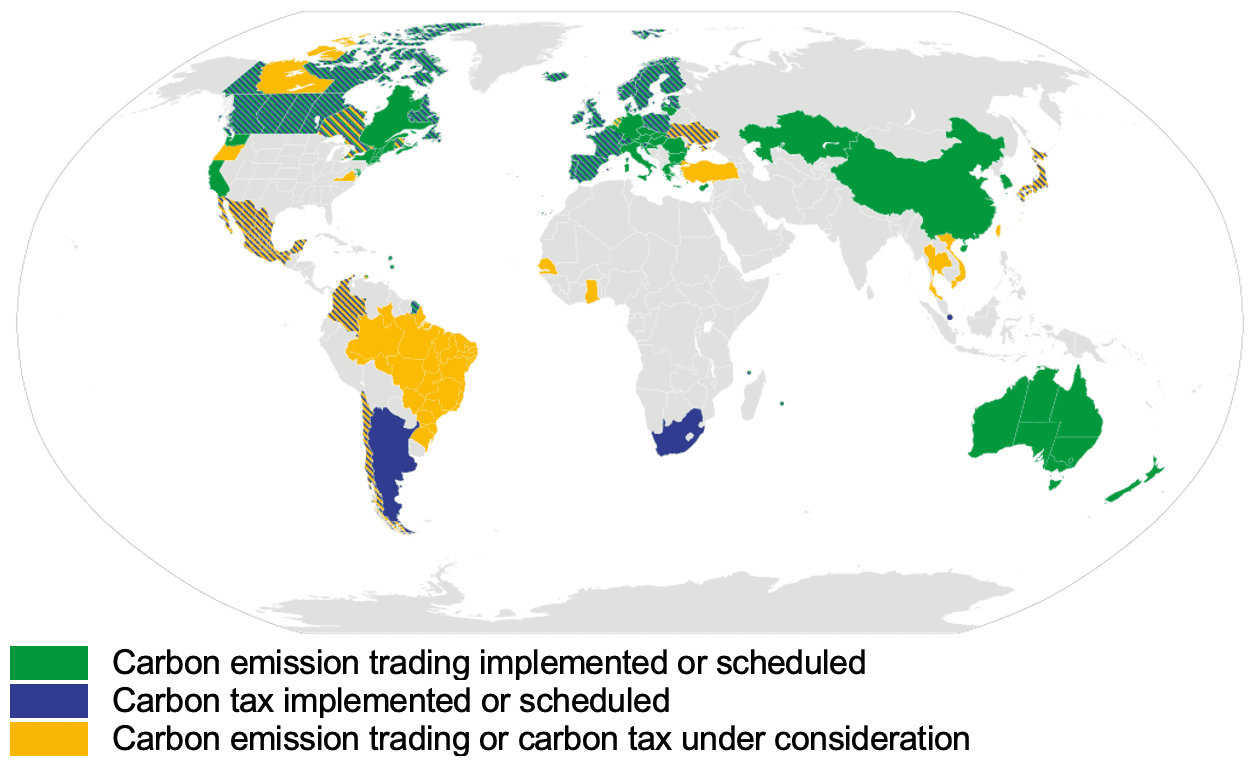
A second approach is the establishment of carbon markets. There are two forms of establishing them, one enforced by a local or regional authority — which will be further explored in this piece — and another that is voluntary, often known as carbon offsetting schemes, where a country/company trades verified emission reduction units to offset a certain tonnage of CO₂ equivalent emitted elsewhere.
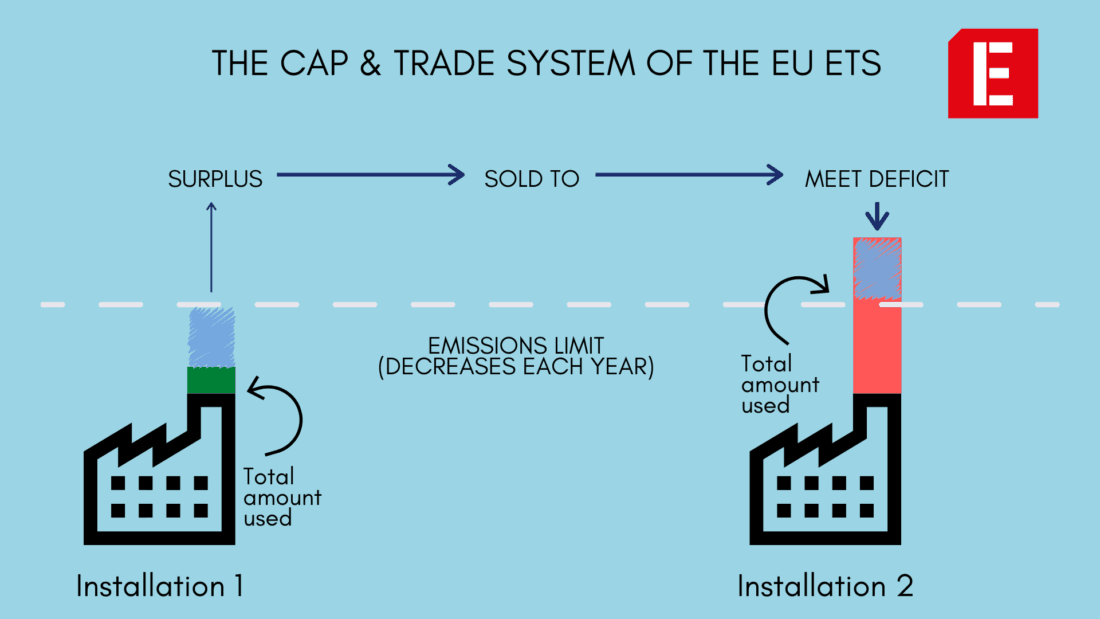
The first model is known as a cap-and-trade scheme. The regulator sets a limit (cap) on pollution and creates enough allowances — normally, each one of them represents 1 tonne of CO₂ equivalent — to meet this cap. After the regulator allocates the permits, they can be bought and sold among the players throughout the year as long as they have enough permits by the end of the set period to give back to the regulator.
Within this logic, a player who faces lower costs to abate emissions is expected to make the necessary investments (e.g., technology) to reduce them. A second player for which this would be more costly will decide to purchase allowances from others. The goal of this system is to encourage the abatement of emissions at the lowest cost.
Regional efforts, such as the Regional Greenhouse Gas Initiative in the United States and the European Union’s Emissions Trading Scheme (EU ETS) are examples of how carbon markets can work successfully. Article 6 of the Paris Agreement envisages it at a global scale in order to help reach its targets, something that will be once again discussed at the Conference of the Parties (COP), next to take place in Glasgow in November 2021.
The EU ETS — implemented in 2005 — was the first international emissions trading scheme. It encompasses 40% of the bloc’s greenhouse gas emissions and has 11,000 heavy energy-using installations from the industrial and power sectors, as well as airlines, as players. While it is hard to disentangle the causal impacts of the EU ETS from the process of reducing emissions which were already underway in Europe, it contributed to a robust negative impact on emissions of 35% between 2005 and 2019 compared to a business-as-usual scenario.
Thus, there are different approaches countries can take to implement a carbon price in their effort to mitigate emissions cost-effectively. This is important as the successful implementation of these mechanisms shares the costs of climate change across generations and is key to achieving our climate targets from a free-market perspective.
This piece is the second article of the SPE London Section Net-zero Committee’s ‘Net Zero 101’ series.