Personal AI system
Project OS
A personal AI system that carries context and decisions across conversations, and turns intentions into work I can review.
01
The problem
I had several useful agents, but I still had to connect their work. They knew different versions of my circumstances, and every new conversation could mean explaining the same things again. Even a decision made in one chat might never reach the files another agent would read. I wanted to describe what I was trying to achieve and trust the system to retrieve the relevant context, preserve decisions, and keep work moving.
02
The approach
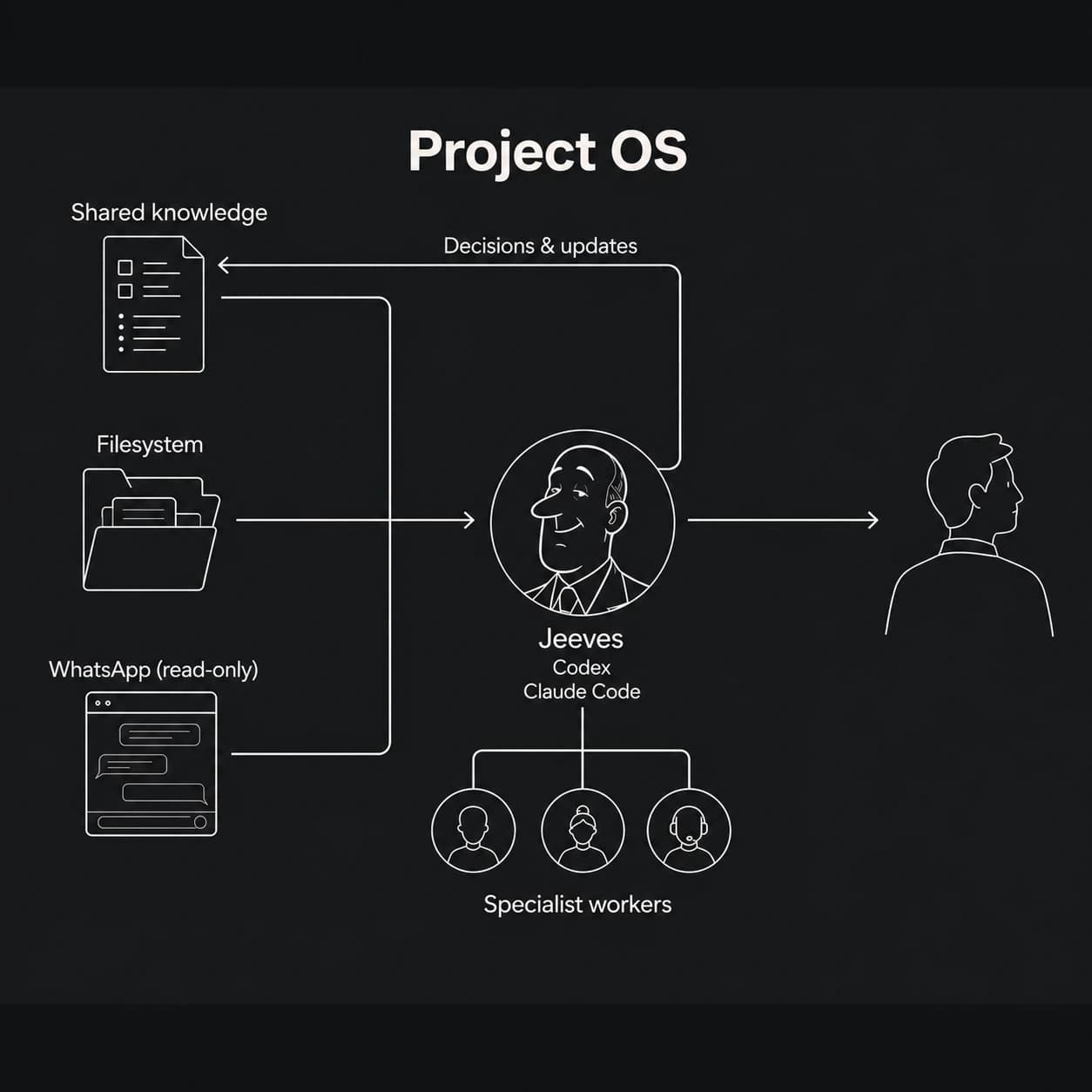
I brought durable context into a personal wiki and organized filesystem, following Karpathy's LLM Wiki idea, and made Jeeves the agent I interact with. Specialist capabilities sit behind him.
Codex is my primary runtime, with Claude Code available when its credits run out. Both use the same operating instructions, personal skills, knowledge, and work records. I can keep starting from the same folder without choosing a project or reconstructing my context.
03
How it works
For a personal question, Jeeves follows an index to the relevant records. For a draft, he reads my voice guide and the appropriate examples. When I make a consequential decision or correction, he updates the affected internal records and keeps track of anything still pending. Checkpoints preserve the objective, permissions, artifacts, and completed actions so another conversation can continue the work.
For delegated tasks, a planning skill turns my intention into a scoped contract in Linear. Approved work has a clear next step: an agent starts, I act, or it waits for a named condition. A background dispatcher picks up agent-owned work, while decisions and actions requiring me return with evidence and a specific request. Scheduled services also deliver briefings to Telegram.
04
Key decisions
- Keep instructions, skills, and durable knowledge shared across the engines I use.
- Retrieve relevant context through an index, with one canonical owner for each record.
- Preserve decisions and work checkpoints so progress can survive a change of conversation.
- Keep authority explicit and handoffs observable, including when the next action belongs to me.
05
Current use
I use the system every day for planning, writing, research, and delegated work. Switching to Claude Code gives me another way to work from the same records; the shared setup itself does not provide automatic failover for scheduled services.
The latest addition is a weekly review of approved sources to update supported facts and flag gaps in the wiki. That revised process is installed, with its first unattended run still to come.
06
What I’ve learned
The work has taught me that useful memory needs maintenance: a correction only helps if it reaches the records the next conversation will read. Continuity also depends on saving progress while work happens, before a credit limit can interrupt it.
Keeping the system understandable takes similar discipline. I now track reviewed source, installed files, and observed behavior separately, because a change in GitHub does not prove the running system has adopted it.